
Research Guides
Ipamorelin and CJC-1295 Research Guide — The Complete Stack

Jul
Ipamorelin and CJC-1295 research peptides are two of the most extensively studied growth hormone secretagogue peptides in endocrine research. Used individually, each compound targets a distinct receptor pathway in the hypothalamic-pituitary axis. Studied in combination, they represent a dual-mechanism research model that has generated significant interest in GH secretion biology, IGF-1 pathway investigation and endocrine axis research. PeptideCores supplies both Ipamorelin peptide and CJC-1295 peptide as independently HPLC verified research grade material at 99%+ purity with batch-specific COA documentation on every order shipped across Europe.
What is Ipamorelin Peptide?
Ipamorelin is a synthetic pentapeptide growth hormone releasing peptide (GHRP) that acts as a selective agonist at the ghrelin receptor — formally known as the growth hormone secretagogue receptor type 1a (GHSR-1a). Developed as a research compound to investigate selective GH axis stimulation, Ipamorelin is notable for its high selectivity for GH release with minimal impact on cortisol, prolactin or ACTH secretion compared to earlier generation GHRPs such as GHRP-2 and GHRP-6.
The molecular formula of Ipamorelin research peptide is C₃₈H₄₉N₉O₅, with a molecular weight of 711.868 g/mol. The peptide sequence is Aib-His-D-2-Nal-D-Phe-Lys-NH₂ — a five amino acid chain with several non-natural amino acid substitutions that confer selectivity and resistance to enzymatic degradation in research settings. In vitro research has demonstrated that Ipamorelin produces dose-dependent GH release from pituitary cell cultures without the pronounced cortisol elevation seen with GHRP-6 at equivalent concentrations.
What is CJC-1295 Peptide?
CJC-1295 is a synthetic analogue of growth hormone releasing hormone (GHRH), specifically a modified version of the naturally occurring GHRH(1-29) fragment. It acts at the GHRH receptor (GHRHR) on pituitary somatotrophs to stimulate GH synthesis and secretion through a fundamentally different pathway than GHRPs like Ipamorelin. Rather than acting via the ghrelin receptor, CJC-1295 directly activates the GHRH receptor — the primary physiological driver of pituitary GH production.
CJC-1295 research peptide is available in two forms that differ significantly in their pharmacokinetic profiles. CJC-1295 without DAC (also known as Modified GRF 1-29) has a relatively short active duration of approximately 30 minutes in research models, producing a more pulse-like GHRH receptor activation pattern. CJC-1295 with DAC incorporates a drug affinity complex that enables albumin binding, dramatically extending its half-life to several days in research models and producing sustained GHRHR activation. The molecular weight of CJC-1295 without DAC is 3367.9 g/mol; with DAC it is 3647.3 g/mol.
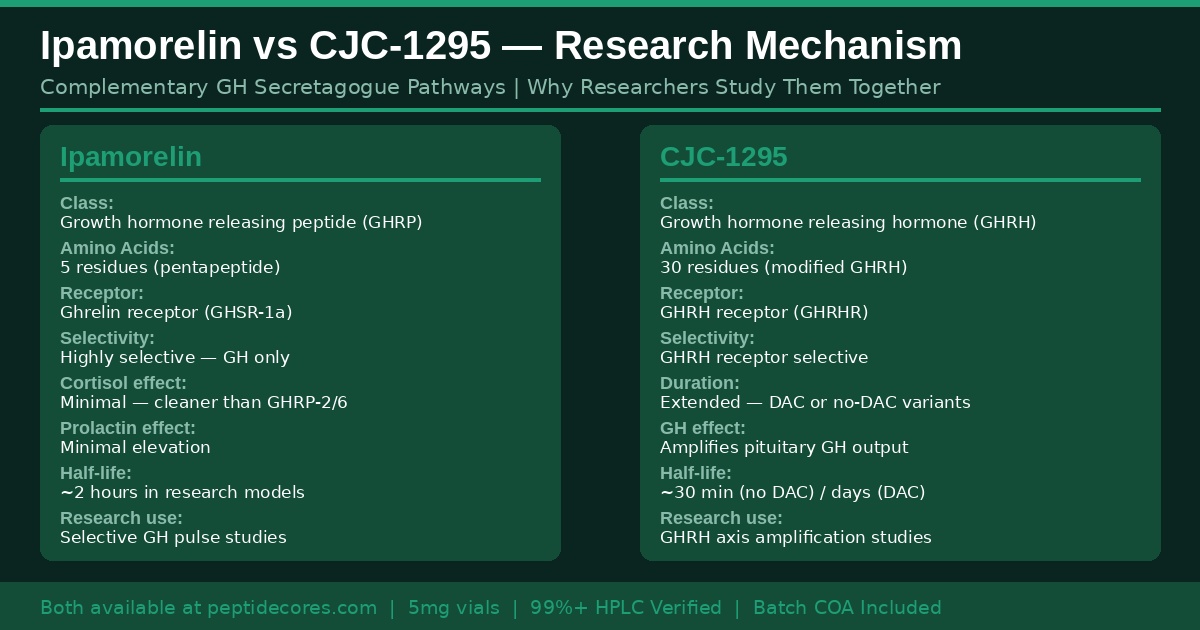
Ipamorelin and CJC-1295 — Complementary Research Mechanisms
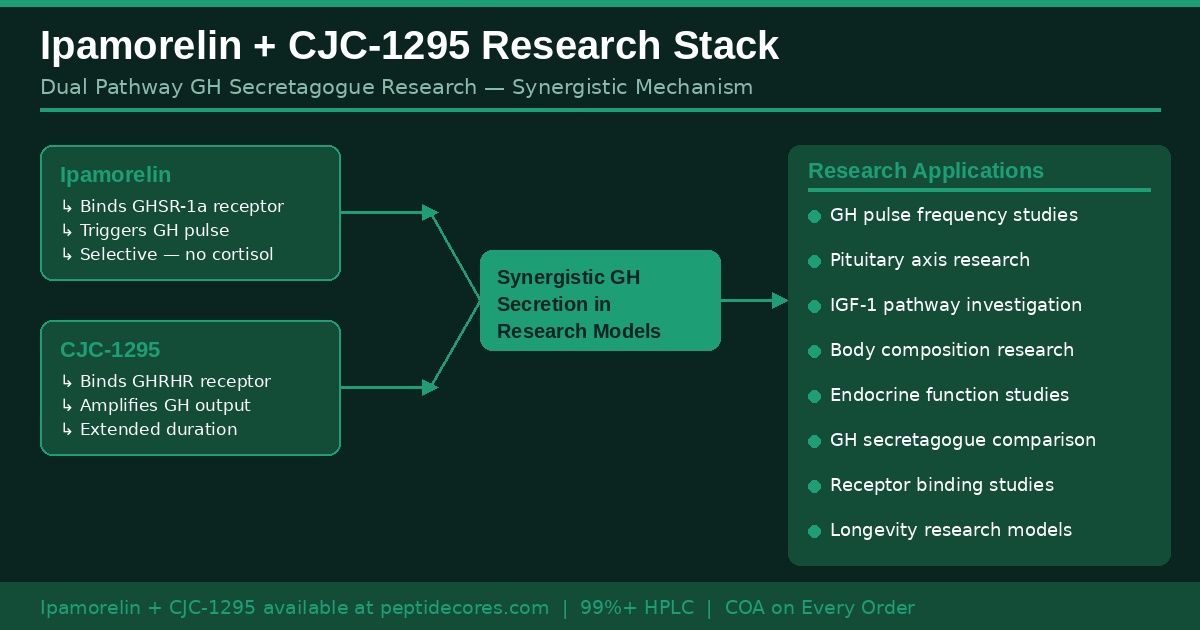
The research interest in studying Ipamorelin and CJC-1295 together stems from the complementary nature of their receptor mechanisms. Ipamorelin activates the ghrelin receptor (GHSR-1a) while CJC-1295 activates the GHRH receptor (GHRHR) — two anatomically and pharmacologically distinct pathways that both converge on pituitary somatotrophs to stimulate GH release.
Research in pituitary biology has demonstrated that simultaneous activation of both the ghrelin and GHRH receptor pathways produces a synergistic amplification of GH secretion that exceeds the additive effect of activating either pathway alone. This synergy is thought to result from complementary intracellular signalling mechanisms — GHRH receptor activation increases cAMP via Gs coupling, while ghrelin receptor activation increases intracellular calcium and activates protein kinase C via Gq/11 coupling. The convergence of these two distinct intracellular signals on the GH secretory machinery produces amplified GH release in research models.
For research programmes investigating the physiology of GH secretion, the ability to study dual-pathway versus single-pathway activation using Ipamorelin and CJC-1295 as selective pharmacological tools provides significant experimental resolution that is not achievable with recombinant HGH or non-selective GH secretagogues.
Research Applications — Ipamorelin and CJC-1295
GH Axis Biology
Ipamorelin and CJC-1295 are used as research tools to investigate the physiological regulation of GH secretion in in vitro and in vivo models. The ability to selectively activate ghrelin receptor versus GHRH receptor pathways — or both simultaneously — provides experimental resolution of the respective contributions of each pathway to basal and stimulated GH secretion.
IGF-1 Pathway Research
GH secreted in response to Ipamorelin and CJC-1295 in research models drives hepatic IGF-1 production, making these compounds useful tools for programmes investigating the GH-IGF-1 axis and its downstream effects on cellular proliferation, protein synthesis and metabolic regulation in research settings.
Pituitary Responsiveness Studies
CJC-1295 without DAC is particularly useful in research protocols designed to test pituitary somatotroph responsiveness to GHRH receptor stimulation, as its short active duration allows repeated stimulation tests with defined inter-dose intervals — similar to established pituitary function testing paradigms.
Body Composition and Metabolic Research
GH secretagogue-induced GH and IGF-1 elevation has been studied in research models investigating body composition, lean mass regulation, adipose tissue metabolism and metabolic rate. Ipamorelin and CJC-1295 are frequently used compounds in these research areas given their well-characterised receptor profiles and extensive published research literature.
Sourcing Ipamorelin and CJC-1295 Research Peptides in Europe
For European researchers sourcing Ipamorelin and CJC-1295, independent purity verification is essential for experimental reproducibility. PeptideCores supplies both compounds as independently HPLC verified research grade material at 99%+ purity with mass spectrometry molecular identity confirmation. Every order includes a batch-specific Certificate of Analysis from an independent third-party laboratory.
Alongside Ipamorelin and CJC-1295, PeptideCores also supplies GHRP-2, GHRP-6, Hexarelin and Sermorelin — providing European researchers with access to a complete GH secretagogue research range from a single verified supplier with COA documentation on every compound.
Frequently Asked Questions
What is the difference between Ipamorelin and CJC-1295?
Ipamorelin is a GHRP that acts at the ghrelin receptor (GHSR-1a). CJC-1295 is a GHRH analogue that acts at the GHRH receptor (GHRHR). They target entirely different receptors and produce GH release through complementary intracellular signalling pathways.
What is the difference between CJC-1295 with DAC and without DAC?
CJC-1295 without DAC (Modified GRF 1-29) has a short active duration of approximately 30 minutes in research models. CJC-1295 with DAC incorporates an albumin-binding moiety that extends its half-life to several days, producing sustained GHRH receptor activation in research settings.
What purity are your Ipamorelin and CJC-1295 peptides?
Both Ipamorelin and CJC-1295 peptides supplied by PeptideCores are independently HPLC verified at 99%+ purity with mass spectrometry molecular identity confirmation. Batch-specific COA documentation is included with every order.
Do you ship Ipamorelin and CJC-1295 to Europe?
Yes. PeptideCores ships both Ipamorelin and CJC-1295 research peptides to all European countries. Delivery typically arrives within 5 to 10 business days with full tracking from dispatch.
Can I request COA documentation before ordering?
Yes. Contact our team via the contact page and we will provide the current batch Certificate of Analysis for Ipamorelin, CJC-1295 or any other compound before you place your order.
Conclusion
Ipamorelin and CJC-1295 represent two of the most pharmacologically well-characterised GH secretagogue peptides available for research use, with complementary receptor mechanisms that make them particularly valuable as paired tools for investigating the hypothalamic-pituitary GH axis. Whether studied individually for selective pathway investigation or together for dual-mechanism research, both compounds offer significant research utility for programmes in endocrine biology, IGF-1 axis research, body composition science and pituitary function investigation.
Browse our full range of GH secretagogue research peptides in Europe or order Ipamorelin and CJC-1295 directly — every order includes independent COA verification and is dispatched within 24 hours across Europe.
Disclaimer
All peptides supplied by PeptideCores are intended for laboratory research purposes only. They are not intended for human or veterinary use, diagnosis, treatment or prevention of any condition or disease. Only qualified researchers should handle these compounds in appropriate laboratory settings following all relevant safety guidelines and regulations.
