Research Guides
HGH Peptides vs HGH — What Researchers Need to Know
Jul
Understanding the distinction between HGH peptides and recombinant human growth hormone is fundamental to designing sound research protocols in endocrine biology. While both categories involve the growth hormone axis, HGH peptides — specifically the class of compounds known as GH secretagogues — operate through entirely different mechanisms than direct recombinant HGH administration. At PeptideCores, we supply a comprehensive range of HPLC verified GH secretagogue peptides for European researchers, each supplied with independent third-party COA documentation on every order.
What Are HGH Peptides?
HGH peptides is a broad term used in research contexts to describe synthetic peptide compounds that stimulate endogenous growth hormone secretion from the anterior pituitary gland, rather than supplying growth hormone directly. These compounds are more precisely termed GH secretagogues and fall into two mechanistic classes — growth hormone releasing peptides (GHRPs) and growth hormone releasing hormone analogues (GHRH analogues).
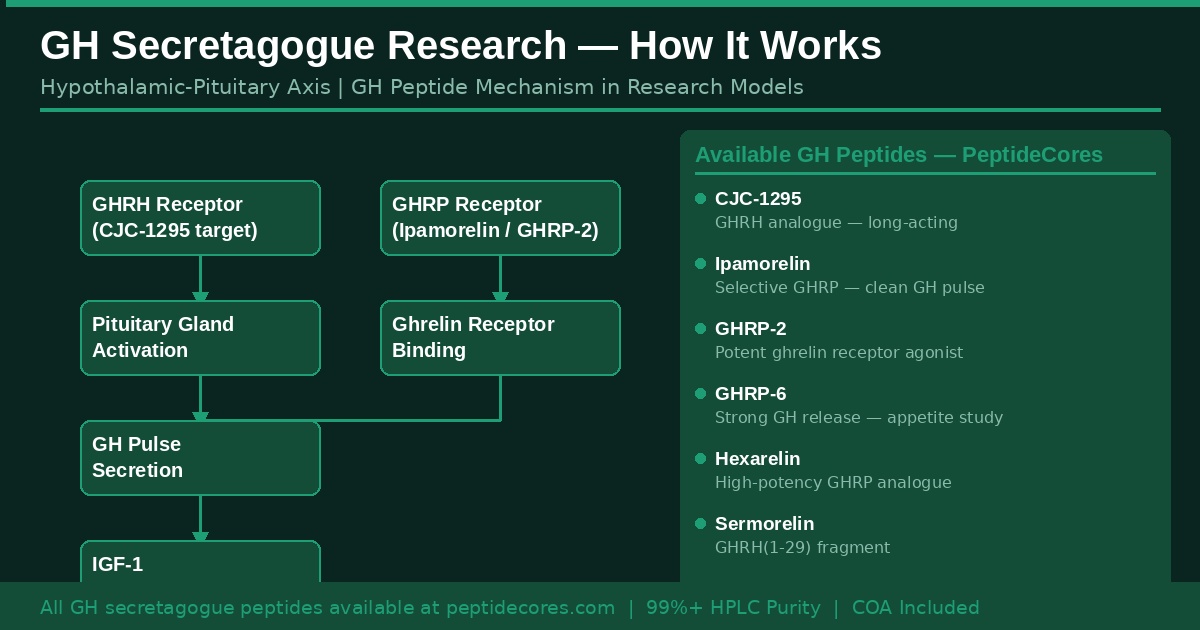
GHRPs such as Ipamorelin peptide, GHRP-2 and GHRP-6 act at the ghrelin receptor (GHSR-1a) in the pituitary and hypothalamus to stimulate GH pulse release. GHRH analogues such as CJC-1295 peptide and Sermorelin act at the GHRH receptor on pituitary somatotrophs to amplify GH secretion. Both classes work upstream of GH itself — they stimulate the body’s own GH production rather than replacing it.
Recombinant HGH vs HGH Peptides — Core Research Differences
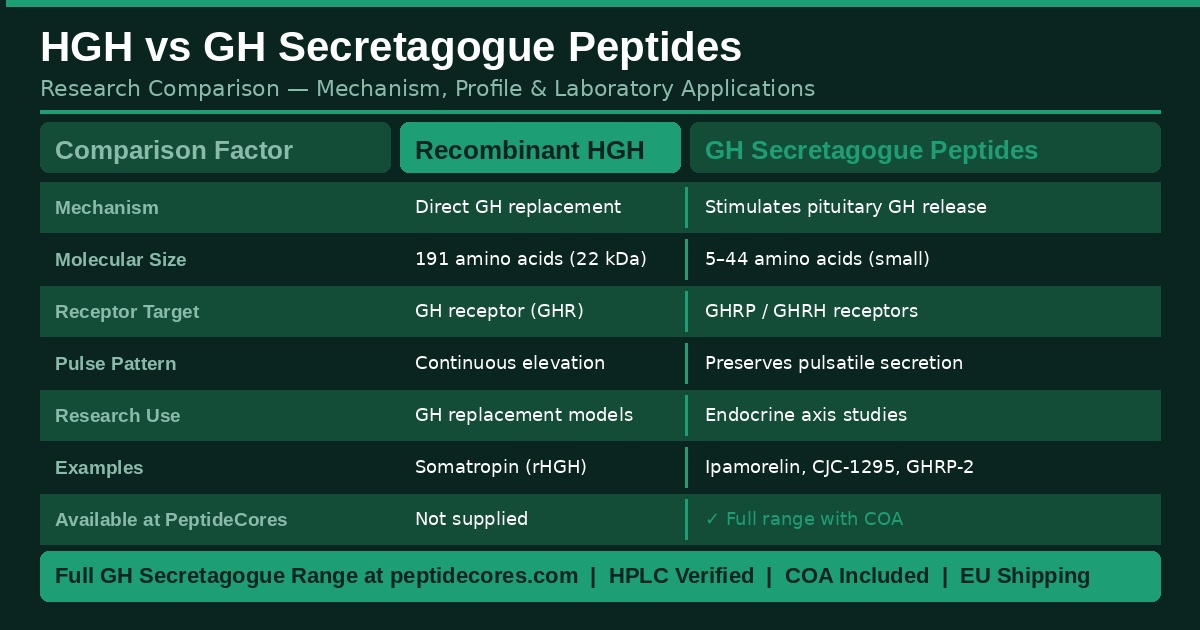
Recombinant human growth hormone (rHGH, also known as somatropin) is a 191 amino acid protein produced via recombinant DNA technology that is structurally identical to pituitary-derived human GH. It acts directly at the growth hormone receptor (GHR) on target tissues. This is fundamentally different from HGH peptides which do not bind GHR directly but instead stimulate pituitary GH release through upstream receptor pathways.
A key research distinction concerns the pattern of GH elevation. Recombinant HGH produces a sustained, non-pulsatile elevation of GH and IGF-1 in research models. HGH peptides — particularly GHRPs — preserve and amplify the natural pulsatile pattern of GH secretion that is characteristic of endogenous GH physiology. This distinction has significant implications for research programmes investigating GH axis physiology and the downstream consequences of different GH secretion patterns on target tissue responses.
GH Secretagogue Peptides Available for Research
PeptideCores supplies a complete range of GH secretagogue HGH peptides for European researchers. Every compound is independently HPLC verified at 99%+ purity with mass spectrometry identity confirmation and a batch-specific Certificate of Analysis included on every order.
GHRP Class — Ghrelin Receptor Agonists
Ipamorelin peptide is a highly selective pentapeptide GHRP that stimulates GH release with minimal effect on cortisol or prolactin secretion in research models — making it a valuable tool for studying selective GH axis activation. GHRP-2 and GHRP-6 are more potent GHRPs studied for their stronger GH releasing capacity and their effects on appetite signalling via ghrelin receptor pathways. Hexarelin is a high-potency synthetic hexapeptide GHRP studied in both GH secretion and cardiovascular receptor binding research.
GHRH Class — Pituitary Amplifiers
CJC-1295 peptide is a modified GHRH analogue available in two research variants — with and without drug affinity complex (DAC). The DAC version produces an extended duration of GHRH receptor activation due to albumin binding, while the no-DAC version (also known as Modified GRF 1-29) produces a shorter-acting pulse. Sermorelin is a truncated GHRH(1-29) fragment studied extensively in research models of GH axis function and pituitary responsiveness.
Why Researchers Choose HGH Peptides Over Recombinant HGH
Several research considerations favour the use of GH secretagogue HGH peptides over direct recombinant HGH in laboratory settings. GH secretagogues are significantly smaller molecules — Ipamorelin at 5 amino acids versus somatropin at 191 — making them more amenable to chemical synthesis, easier to work with in laboratory environments and more cost-effective for research budgets.
The preservation of pulsatile GH secretion by GHRPs more closely reflects endogenous GH physiology than continuous GH elevation from exogenous rHGH, making secretagogue peptides more suitable for research programmes investigating physiological GH axis function. Additionally, the ability to selectively target either the ghrelin receptor (GHRP class) or the GHRH receptor (GHRH class) allows researchers to dissect the distinct contributions of each pathway to overall GH secretion — an experimental approach that is not possible with direct recombinant HGH.
Sourcing HGH Peptides for Research in Europe
For European researchers sourcing GH secretagogue HGH peptides, independent purity verification is essential for experimental reliability. PeptideCores supplies a complete GH secretagogue range — including Ipamorelin, CJC-1295, GHRP-2, GHRP-6, Hexarelin and Sermorelin — as independently HPLC verified research grade material at 99%+ purity. Every order includes a batch-specific Certificate of Analysis from an independent third-party laboratory covering HPLC purity results and mass spectrometry molecular identity confirmation.
All orders are dispatched to European destinations within 24 hours with full tracking. Researchers requiring COA documentation prior to ordering can request the current batch certificate via our contact page.
Frequently Asked Questions — HGH Peptides
What is the difference between HGH peptides and HGH?
HGH peptides — also called GH secretagogues — stimulate the pituitary gland to release its own growth hormone via GHRP or GHRH receptor pathways. Recombinant HGH (somatropin) is a 191 amino acid protein that directly activates the GH receptor on target tissues. They operate through entirely different mechanisms and receptor systems.
Which HGH peptides does PeptideCores supply?
PeptideCores supplies Ipamorelin, CJC-1295 (with and without DAC), GHRP-2, GHRP-6, Hexarelin and Sermorelin — all independently HPLC verified at 99%+ purity with COA documentation included on every order.
Do you ship HGH peptides to Europe?
Yes. PeptideCores ships all GH secretagogue research peptides to every European country with delivery typically within 5 to 10 business days and full tracking provided from dispatch.
What purity are your HGH peptides?
All GH secretagogue peptides supplied by PeptideCores are independently HPLC verified at 99%+ purity with mass spectrometry identity confirmation. The batch-specific COA is included with every order.
Can I get a COA before ordering?
Yes. Contact our team via the contact page and we will provide the current batch Certificate of Analysis for any compound before you place an order.
Conclusion
HGH peptides — properly understood as GH secretagogue compounds — represent a distinct and research-relevant category of compounds that operate upstream of GH itself, preserving the physiological pulsatility of GH secretion while allowing selective investigation of either GHRP or GHRH receptor pathways. For researchers studying the GH axis, endocrine physiology, IGF-1 biology or body composition mechanisms, GH secretagogue peptides offer significant advantages over direct recombinant HGH as laboratory research tools.
Browse our complete range of GH secretagogue research peptides — including Ipamorelin and CJC-1295 — all independently verified and dispatched across Europe within 24 hours.
Disclaimer
All peptides supplied by PeptideCores are intended for laboratory research purposes only. They are not intended for human or veterinary use, diagnosis, treatment or prevention of any condition or disease. Only qualified researchers should handle these compounds in appropriate laboratory settings following all relevant safety guidelines and regulations.
