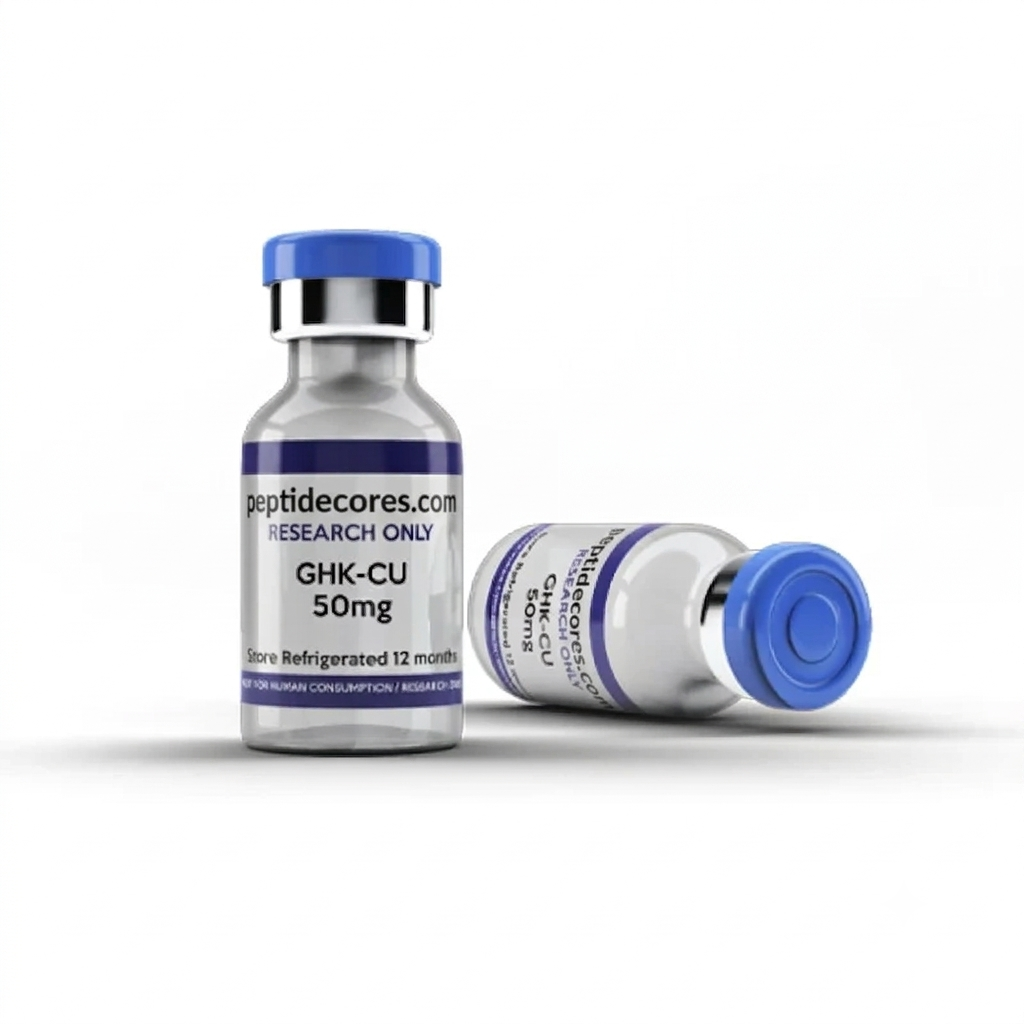
GHK-Cu peptide is a naturally occurring copper
complex of the tripeptide Glycine-Histidine-Lysine.
First isolated from human plasma, GHK-Cu peptide
has since become one of the most studied compounds
in skin biology and cellular research worldwide.
TECHNICAL SPECIFICATIONS
Molecular Formula: C14H24CuN6O4
Molecular Weight: 403.9 g/mol
Purity: ≥99% by HPLC
Appearance: Blue lyophilised powder
Storage: Store at -20°C
CAS Number: 89030-95-5
ABOUT GHK-Cu PEPTIDE RESEARCH
GHK-Cu peptide has been extensively studied in
cellular biology and skin science research
environments. As a copper binding tripeptide,
GHK-Cu peptide has a distinctive blue appearance
due to its copper complex structure — making it
one of the most recognisable research peptides
available today.
Research involving GHK-Cu peptide has been
published across multiple peer reviewed journals
covering areas of cellular biology, skin science
and wound healing research. The compound has
demonstrated excellent stability under standard
laboratory conditions.
GHK-Cu peptide is particularly popular in
anti-aging research due to its unique molecular
structure and copper binding properties.
Researchers studying skin biology and cellular
regeneration frequently include GHK-Cu peptide
in their experimental protocols.
PURITY AND QUALITY ASSURANCE
Every batch of GHK-Cu peptide supplied by
PeptideCores undergoes rigorous independent
third-party testing before dispatch. Our quality
assurance process includes the following steps.
High Performance Liquid Chromatography testing
confirms purity at 99% or above. Mass spectrometry
confirms molecular identity and copper binding
properties. A full Certificate of Analysis is
issued for every batch with complete documentation
available on request.
For optimal stability GHK-Cu should be
stored at minus 20 degrees Celsius in a dry
environment away from direct light and moisture.
Under these conditions the compound remains
stable for up to 24 months from manufacture date.
Note that GHK-Cu peptide has a distinctive blue
colour due to its copper complex — this is normal
and expected. Once reconstituted store at 4
degrees Celsius and use within appropriate
research timelines.
WHY CHOOSE PEPTIDECORES FOR GHK-Cu
PeptideCores supplies GHK-Cu peptide exclusively
for laboratory and research purposes. Each order
includes a Certificate of Analysis confirming
purity and copper binding composition. We ship
worldwide in discreet temperature appropriate
packaging to maintain compound integrity.
Our GHK-Cu is sourced from certified
manufacturers and undergoes strict quality control
at every stage before dispatch. Research integrity
depends on compound purity and we never compromise
on our quality standards.
ORDERING AND SHIPPING
GHK-Cu peptide orders are processed within 24
hours of payment confirmation. We ship worldwide
in discreet packaging with no reference to
contents on outer packaging. All international
shipments are fully tracked from dispatch through
to delivery.
RELATED RESEARCH PEPTIDES
GHK-Cu is frequently studied alongside
other anti-aging research compounds. Related
peptides available from PeptideCores include
BPC-157 peptide, TB-500 peptide, Ipamorelin
peptide and CJC-1295 peptide. All products meet
the same rigorous purity and quality standards.
FREQUENTLY ASKED QUESTIONS
What is the purity of your GHK-Cu?
Our GHK-Cu peptide is HPLC verified at 99% plus
purity. A full Certificate of Analysis is included
with every order dispatched from PeptideCores.
Why is GHK-Cu blue in colour?
GHK-Cu peptide has a distinctive blue appearance
due to its copper complex molecular structure.
This is completely normal and expected for this
research compound.
How should GHK-Cu be stored?
Store lyophilised GHK-Cu peptide at minus 20
degrees Celsius away from light and moisture.
Stable for up to 24 months under these storage
conditions.
DISCLAIMER
This product is intended for laboratory research
purposes only. It is not intended for human or
veterinary use, diagnosis, treatment or prevention
of any condition or disease. Only qualified
researchers should handle this compound in
appropriate laboratory settings following all
relevant safety guidelines.
Be the first to review “GHK-Cu Peptide | 50mg | Research Grade”
Related products
Metabolic Research Peptides
Performance Research Peptides
Weight Management
Performance Peptides
Performance Research Peptides
Anti-Aging Peptides
Anti-Aging Peptides
Performance Peptides
Reviews
There are no reviews yet.