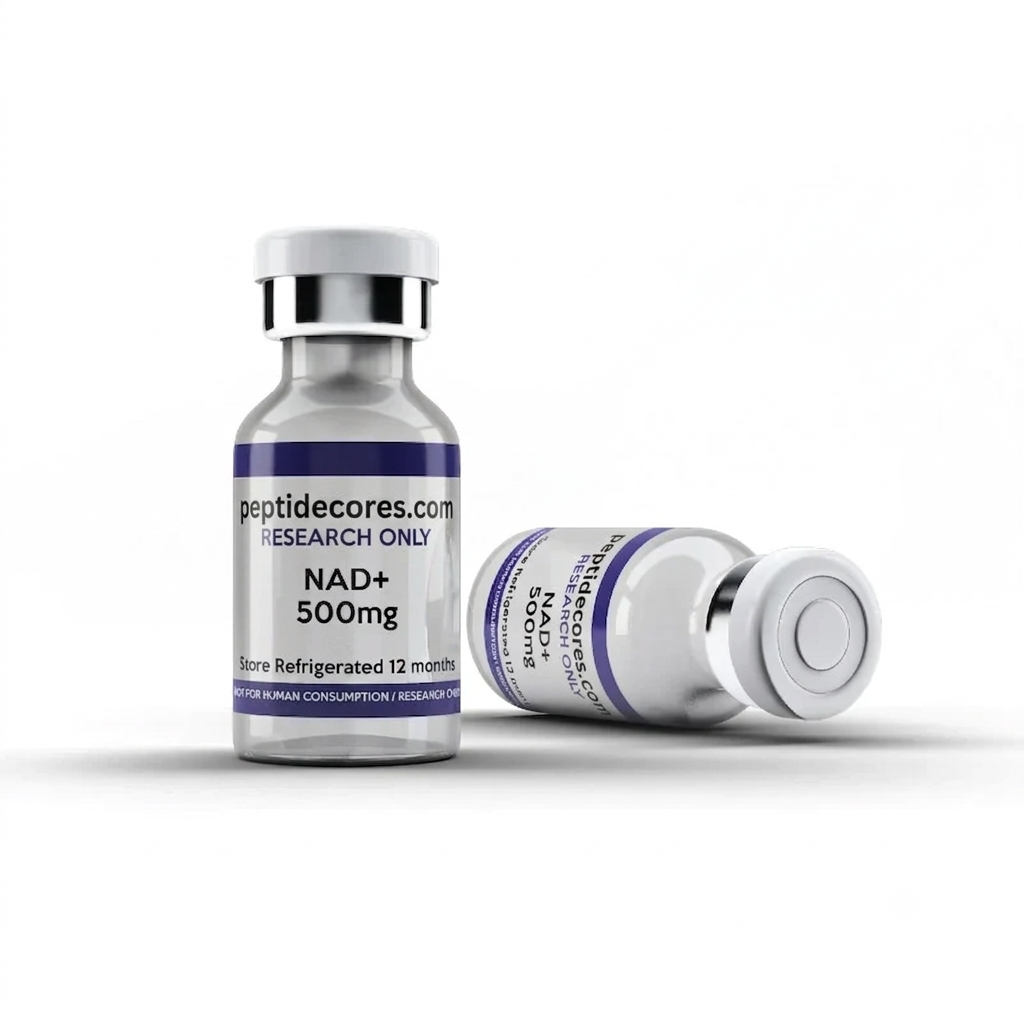
NAD+ peptide (Nicotinamide Adenine Dinucleotide) is
a naturally occurring coenzyme present in all
living cells and essential to cellular energy
metabolism. NAD+ plays a fundamental role in
redox reactions, serving as an electron carrier
in metabolic pathways and as a substrate for
various regulatory enzymes including sirtuins
and poly ADP-ribose polymerases. As one of
the most extensively studied molecules in
biochemistry, NAD+ research spans cellular
metabolism, longevity biology, mitochondrial
function and epigenetic regulation.
TECHNICAL SPECIFICATIONS
Molecular Formula: C21H27N7O14P2
Molecular Weight: 663.43 g/mol
Purity: ≥99% by HPLC
Appearance: White lyophilised powder
Storage: Store at -20°C
CAS Number: 53-84-9
Form: Oxidised form (NAD+), free acid
ABOUT NAD+ RESEARCH
NAD+ has been extensively studied in cellular
metabolism, longevity biology and energy
research environments worldwide. As a
fundamental coenzyme in cellular energy
production, NAD+ is essential for studying
mitochondrial function, sirtuin activation
and cellular ageing mechanisms in controlled
laboratory environments.
Research involving NAD+ has been published
across thousands of peer reviewed journals
covering cellular metabolism, gerontology,
mitochondrial biology and longevity research.
NAD+ is one of the most studied molecules
in biological research with decades of
published literature supporting its role
in cellular energy metabolism.
NAD+ functions as a coenzyme in over 500
enzymatic reactions in human cells. In its
role as an electron carrier, NAD+ accepts
electrons from metabolic substrates to become
NADH, which then donates electrons to the
mitochondrial electron transport chain for
ATP production. This central role in cellular
energy production makes NAD+ indispensable
for research examining metabolic function
and mitochondrial biology.
Beyond its role in energy metabolism, NAD+
serves as a substrate for several classes
of regulatory enzymes. Sirtuins, a family
of NAD+-dependent deacylases, use NAD+ as
a co-substrate to remove acyl groups from
lysine residues on target proteins including
histones and transcription factors. Research
examining sirtuin activation and the
relationship between NAD+ availability and
sirtuin activity has become a major focus
of longevity biology research.
LONGEVITY AND AGEING RESEARCH
NAD+ peptide levels in research models decline with
age, and this decline has been associated with
multiple age-related changes in cellular
function. Research examining the mechanisms
and consequences of NAD+ decline has made
NAD+ supplementation one of the most studied
interventions in longevity biology. PeptideCores
supplies research-grade NAD+ for in-vitro
studies examining NAD+ metabolism, sirtuin
activation and the relationship between NAD+
levels and cellular ageing markers.
PURITY AND QUALITY ASSURANCE
Every batch of NAD+ peptide supplied by PeptideCores
undergoes rigorous independent third-party
testing. HPLC testing confirms purity at
99% or above. Mass spectrometry confirms
molecular identity. A full Certificate of
Analysis is issued for every batch dispatched.
STORAGE AND HANDLING
For optimal stability NAD+ peptide should be stored
at minus 20 degrees Celsius in a dry
environment away from direct light and
moisture. NAD+ is hygroscopic and particularly
sensitive to moisture — ensure containers
are tightly sealed when not in use. Under
recommended conditions the compound remains
stable for up to 24 months.
WHY CHOOSE PEPTIDECORES FOR NAD+
PeptideCores supplies NAD+ peptide exclusively for
laboratory and research purposes. Each order
includes a Certificate of Analysis confirming
purity. Worldwide discreet shipping on every
order with full tracking provided.
ORDERING AND SHIPPING
orders are processed within 24 hours
of payment confirmation. Worldwide discreet
shipping with full tracking. No reference
to contents on outer packaging.
FREQUENTLY ASKED QUESTIONS
What is the purity of your NAD+ peptide?
it is HPLC verified at 99% plus purity
with a full Certificate of Analysis included
with every order dispatched.
What form of NAD+ do you supply?
PeptideCores supplies NAD+ in the oxidised
form as lyophilised powder at 500mg per vial.
This is the active coenzyme form used in
the majority of in-vitro research applications.
Why is NAD+ Peptide important in longevity research?
it serves as an essential coenzyme for
sirtuin enzymes which regulate numerous
cellular processes associated with ageing.
Research has shown NAD+ levels decline with
age in multiple model systems making it a
central molecule in longevity biology research.
How should NAD+ be stored?
Store at minus 20 degrees Celsius in
a dry environment. NAD+ is moisture sensitive.
Stable for up to 24 months under recommended
storage conditions.
DISCLAIMER
This product is intended for laboratory research
purposes only. It is not intended for human or
veterinary use, diagnosis, treatment or prevention
of any condition or disease. Only qualified
researchers should handle this compound.
Be the first to review “NAD+ | 500mg | Research Grade”
Related products
Research Peptides
Metabolic Research Peptides
Anti-Aging Peptides
Metabolic Research Peptides
Research Peptides
Research Peptides
Research Peptides
Metabolic Research Peptides
Reviews
There are no reviews yet.