
Research Guides
How to Store Research Peptides Correctly — A Complete Storage Guide
Jun
How to store research peptides correctly is one of the most practical questions facing any laboratory working with synthetic peptide compounds. Even the highest purity research peptide can degrade or lose stability if stored incorrectly, compromising research results and wasting valuable compounds. This complete guide covers everything researchers need to know about how to store research peptides — from lyophilised powder storage through to reconstitution and handling of peptide solutions.
Why Correct Storage Matters for Research Peptides
Peptides are inherently less stable than many other classes of research compounds due to their structure. The peptide bonds linking amino acids together can be susceptible to hydrolysis, oxidation and other degradation pathways when exposed to unfavourable conditions such as heat, light, moisture or repeated physical disturbance. Understanding how to store research peptides correctly is therefore not an optional consideration — it directly determines whether the compound a researcher uses at the point of an experiment is the same compound that was originally supplied.
Every research peptide supplied by PeptideCores is HPLC verified at 99%+ purity at the point of dispatch, with a Certificate of Analysis confirming this for the specific batch supplied. However, maintaining that purity from the point of delivery through to the point of use in the laboratory depends entirely on how the peptide is stored and handled by the researcher. This guide explains exactly how to preserve that purity throughout the lifecycle of a research peptide.
Storing Lyophilised Research Peptides
Lyophilised, or freeze-dried, powder is the standard form in which research peptides are supplied, including all products available from PeptideCores. Lyophilisation removes water from the peptide through a freeze-drying process, leaving a stable powder that is significantly more resistant to degradation than a liquid solution. However, lyophilised peptides still require specific storage conditions to maintain this stability over time.
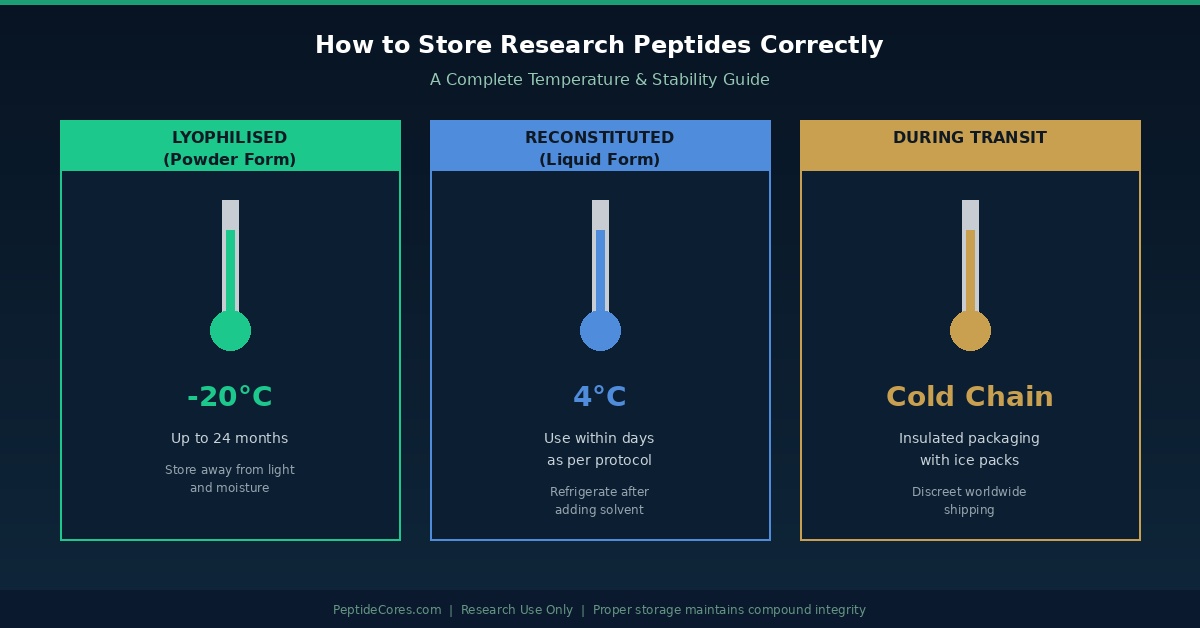
The standard recommendation for storing lyophilised research peptides is minus 20 degrees Celsius, in a standard laboratory freezer, away from direct light and moisture. Under these conditions, most research peptides remain stable for up to 24 months from the date of manufacture. This timeframe applies to compounds across the PeptideCores range, including BPC-157 peptide, TB-500 peptide, GHK-Cu peptide and others.
Moisture is a particular concern for lyophilised peptides because the freeze-drying process leaves the powder highly hygroscopic — meaning it readily absorbs moisture from the surrounding air. Once moisture is reintroduced, degradation pathways that were effectively paused during lyophilisation can resume. This is why vials should remain sealed until ready for use, and why any unused portion should be resealed promptly and returned to appropriate storage conditions.
Light exposure is another factor that can affect peptide stability, particularly for compounds containing amino acids susceptible to photodegradation. Storing vials in their original packaging, in a closed freezer drawer or box, provides adequate light protection for most research applications.
Reconstitution — Converting Lyophilised Peptide to Solution
Reconstitution is the process of dissolving lyophilised peptide powder in a solvent to create a solution suitable for use in research applications. This step is critical, and the way it is performed has a direct impact on peptide integrity going forward.
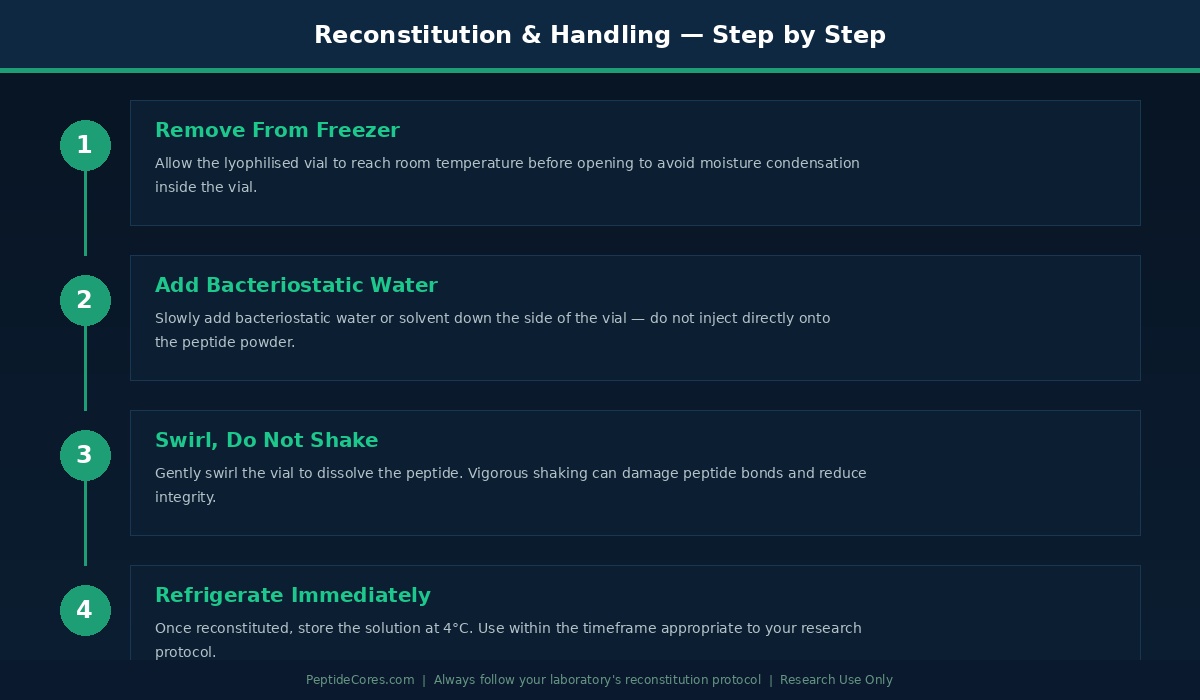
Before opening a lyophilised vial, allow it to reach room temperature first. Opening a cold vial immediately after removing it from the freezer can cause atmospheric moisture to condense inside the vial, introducing water before the intended reconstitution step and potentially affecting the powder.
When adding solvent — commonly bacteriostatic water for research applications — add it slowly down the inside wall of the vial rather than directly onto the powder. A forceful stream of liquid directed at lyophilised powder can cause it to disperse unevenly or create localised concentration issues during dissolution.
Once the solvent has been added, mix by gently swirling the vial rather than shaking it. Peptide bonds and tertiary structure can be sensitive to vigorous mechanical agitation. Gentle swirling is sufficient to fully dissolve most research peptides within a short period and avoids unnecessary physical stress on the molecule.
Storing Reconstituted Peptide Solutions
Once a research peptide has been reconstituted into solution, its stability profile changes significantly compared to the lyophilised powder form. Reconstituted peptide solutions should be stored at 4 degrees Celsius — standard refrigeration temperature — and should generally be used within a timeframe appropriate to the specific research protocol being followed.
The exact stability window for a reconstituted peptide solution depends on the specific peptide, the solvent used, the concentration of the solution and storage conditions. As a general principle, reconstituted solutions are considerably less stable than lyophilised powder and should not be expected to remain viable for the same extended periods. Researchers should plan reconstitution to align with their experimental timeline rather than reconstituting large volumes for extended storage.
Repeated freeze-thaw cycling of reconstituted peptide solution is one of the most common causes of unexpected peptide degradation in laboratory settings. Each freeze-thaw cycle introduces physical stress and can promote aggregation or degradation. Where possible, reconstituted solutions should be divided into single-use aliquots before freezing, so that only the required volume is thawed for each use rather than repeatedly freezing and thawing the entire stock.
Storage During Shipping and Transit
PeptideCores ships all research peptides worldwide in packaging designed to protect compound integrity during transit. Lyophilised peptides are generally more robust to short-term temperature fluctuations during shipping than reconstituted solutions would be, which is one of the practical advantages of lyophilised powder as a supply format.
Upon receiving a research peptide order, researchers should transfer vials to appropriate freezer storage as soon as practical. While lyophilised peptides can typically tolerate brief periods at ambient temperature during transit and unpacking without significant impact, extended periods outside of recommended storage conditions should be avoided.
Common Storage Mistakes to Avoid
Several recurring mistakes account for the majority of avoidable peptide stability issues encountered in research settings. Being aware of these helps researchers maximise the usable life of their research peptide stock.
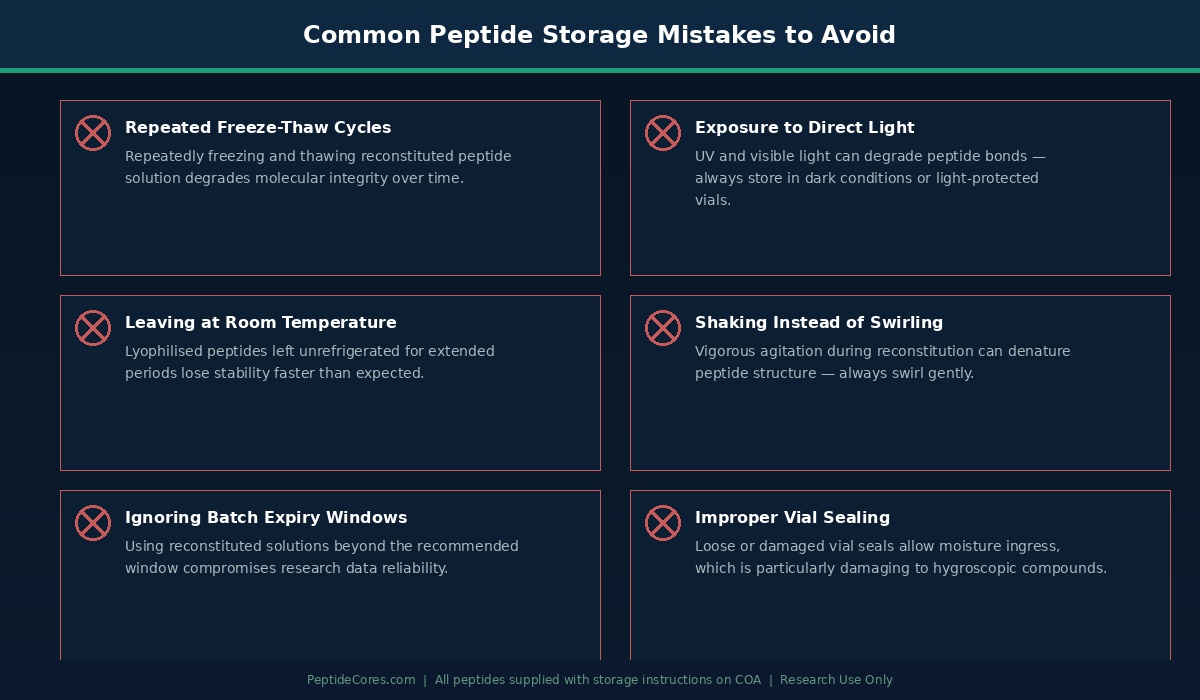
Repeated freeze-thaw cycles. As discussed above, repeatedly freezing and thawing reconstituted solution is one of the most damaging things a researcher can do to peptide stability. Aliquoting solutions before freezing avoids this entirely.
Exposure to direct light. Leaving vials on a benchtop under laboratory lighting for extended periods, rather than returning them to dark storage, can contribute to gradual photodegradation over time.
Leaving lyophilised powder at room temperature. Even though lyophilised peptides are more stable than solutions, leaving vials at room temperature for days or weeks rather than promptly returning them to minus 20 degrees Celsius storage shortens their effective shelf life.
Shaking instead of swirling during reconstitution. Vigorous shaking introduces unnecessary mechanical stress at exactly the point where the peptide is most vulnerable — newly dissolved and not yet at stable storage temperature.
Ignoring batch-specific guidance. The Certificate of Analysis supplied with each PeptideCores order includes storage guidance specific to that batch. Always refer to this documentation alongside general best practice guidelines.
Improper vial sealing after use. If only part of a vial’s contents is used, ensure the vial is properly resealed before returning it to storage. A loose or damaged seal allows moisture ingress that can affect the remaining lyophilised material.
Storage Guidance Summary
To summarise the key storage parameters for research peptides:
Lyophilised powder: Store at minus 20°C, away from light and moisture. Stable for up to 24 months from manufacture date under these conditions.
Reconstituted solution: Store at 4°C. Use within the timeframe specified by your research protocol. Avoid repeated freeze-thaw cycles by aliquoting before freezing.
During reconstitution: Allow vial to reach room temperature before opening. Add solvent slowly down the vial wall. Mix by gentle swirling, never shaking.
General handling: Keep vials sealed when not in use. Minimise light exposure. Return to appropriate storage promptly after each use.
How PeptideCores Supports Correct Storage
Every product supplied by PeptideCores includes storage guidance on the Certificate of Analysis, specific to that batch. Our entire range — including Ipamorelin peptide, CJC-1295 peptide, NAD+, AOD-9604 peptide and MOTS-c peptide — is supplied as lyophilised powder, HPLC verified at 99%+ purity, packaged to maintain stability during worldwide discreet shipping.
Browse our full range of research peptides — every order includes full storage and handling guidance alongside your Certificate of Analysis.
Frequently Asked Questions
How long can lyophilised research peptides be stored?
Lyophilised research peptides stored at minus 20°C away from light and moisture remain stable for up to 24 months from the date of manufacture.
Can I refreeze a reconstituted peptide solution?
Repeated freeze-thaw cycles are not recommended as they can degrade peptide integrity. Where extended storage of reconstituted solution is needed, divide it into single-use aliquots before the first freeze.
What is the best solvent for reconstituting research peptides?
Bacteriostatic water is commonly used for reconstituting research peptides. Always follow your laboratory’s specific protocol for solvent selection.
Does PeptideCores provide storage instructions with orders?
Yes. Every order includes a Certificate of Analysis with storage guidance specific to the batch supplied.
Conclusion
Knowing how to store research peptides correctly is essential to preserving the purity and integrity that careful sourcing and HPLC verification provide in the first place. From minus 20°C storage of lyophilised powder, to careful reconstitution technique, to 4°C storage of solutions and avoidance of repeated freeze-thaw cycles — each step in the storage chain matters. PeptideCores supplies every research peptide as HPLC verified lyophilised powder with full storage guidance included, giving researchers the best possible starting point for maintaining compound integrity throughout their work.
Disclaimer
All peptides supplied by PeptideCores are intended for laboratory research purposes only. They are not intended for human or veterinary use, diagnosis, treatment or prevention of any condition or disease. Only qualified researchers should handle these compounds in appropriate laboratory settings following all relevant safety guidelines and regulations. and How to store research peptides is an article to guide researchers on the proper storage practices hence answering the How to store research peptides questions
