
Research Guides
PeptideCores-Your Trusted Peptide Supplier with COA Verification
Jun
Finding a reliable peptide supplier with COA verification is one of the most important decisions any research laboratory makes. A Certificate of Analysis is not simply a document — it is the documented proof that the research peptide compound supplied meets the purity specification claimed and has been independently verified to be exactly what it states on the label. At PeptideCores, we are a dedicated peptide supplier with COA verification included on every single order as standard, covering our full range of HPLC verified research peptides shipped across Europe and worldwide.
What Makes a Trustworthy Peptide Supplier with COA?
Not all peptide suppliers with COA documentation provide the same level of verification. Understanding what separates genuine third-party COA verification from superficial documentation helps researchers make informed decisions about the compounds they work with.
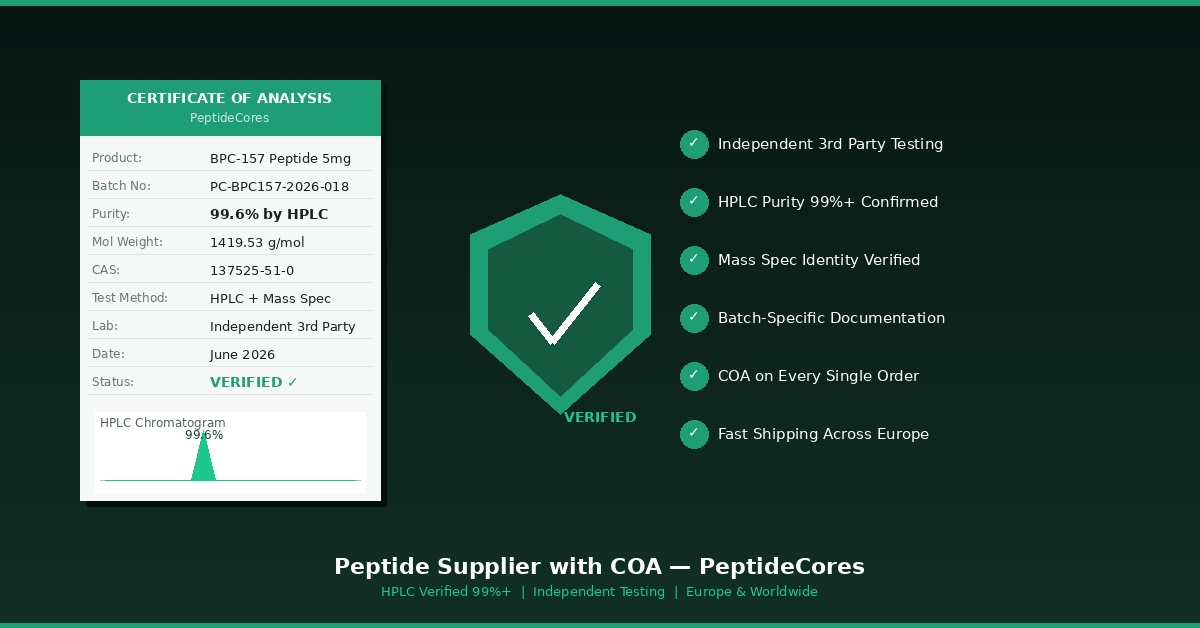
A genuinely trustworthy peptide supplier with COA should provide batch-specific documentation — meaning the Certificate of Analysis corresponds to the exact batch number printed on the vial you receive, not a generic certificate that applies to any batch. The COA should include High Performance Liquid Chromatography purity results confirming the target peptide percentage, mass spectrometry confirmation of molecular identity, the name of the independent third-party laboratory that performed the testing, and the date the analysis was conducted.
PeptideCores operates as a peptide supplier with COA documentation meeting all of these criteria. Every Certificate of Analysis we provide is batch-specific, includes independent third-party HPLC testing confirming purity at 99% or above, and includes mass spectrometry molecular identity confirmation. This applies across our entire research peptide range including BPC-157 peptide, TB-500 peptide, GHK-Cu peptide and every other compound we supply.
Why Researchers Need a Peptide Supplier with COA Verification
Research integrity depends entirely on compound purity. When a researcher chooses a peptide supplier with COA documentation, they are making a decision that directly affects the reliability of their experimental data. An impure compound can produce misleading results, invalidate months of research work or make it impossible to draw reproducible conclusions from experimental data.
The consequences of sourcing from a peptide supplier without proper COA verification are significant. If a peptide is significantly less pure than stated, contains unexpected synthesis byproducts or is not the compound listed on the label, any research conclusions drawn from experiments using that compound become unreliable. In institutional settings, sourcing research compounds from a verified peptide supplier with COA is often a compliance requirement under good laboratory practice guidelines.
Beyond research integrity, the documentation provided by a reliable peptide supplier with COA serves an important record-keeping function. Many research institutions require documentation of reagent and compound purity to be maintained as part of standard laboratory records. A batch-specific Certificate of Analysis from an independent testing laboratory fulfils this requirement in a way that supplier claims alone cannot.
PeptideCores — A Peptide Supplier with COA on Every Order
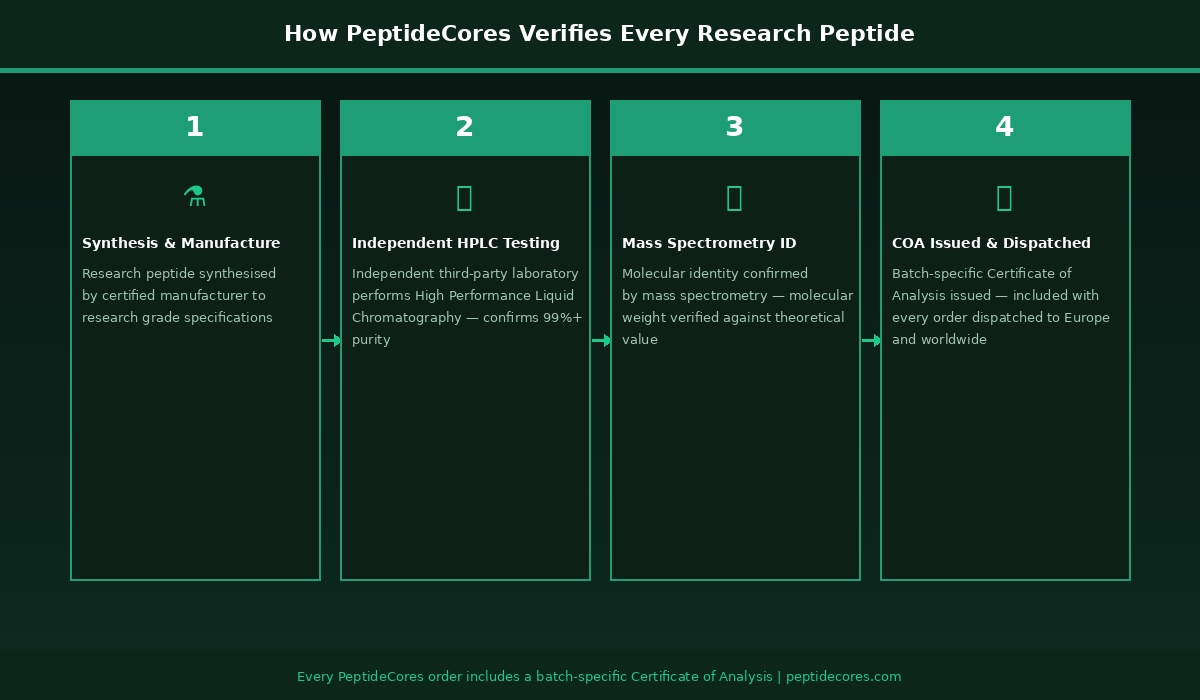
PeptideCores was established specifically to serve researchers who need a peptide supplier with COA verification they can trust. Our quality assurance process begins before any product is dispatched and involves three distinct verification steps that collectively ensure compound identity, purity and documentation integrity.
Every batch of research peptide supplied by PeptideCores is first tested by an independent third-party laboratory using High Performance Liquid Chromatography. HPLC testing separates the sample components and measures the relative area of each peak in the chromatogram. A result of 99% or above means the target peptide constitutes at least 99% of the total sample with no more than 1% attributable to impurities, synthesis byproducts or related compounds.
Mass spectrometry is then applied to confirm the molecular identity of the compound independently of the purity measurement. By measuring the mass-to-charge ratio of the sample ions, mass spectrometry confirms the compound’s molecular weight matches the theoretical value calculated from the peptide’s amino acid sequence. For BPC-157 peptide this expected value is 1419.53 g/mol. For TB-500 peptide the expected value is 4963.5 g/mol. These values are confirmed in the Certificate of Analysis accompanying each order.
The resulting Certificate of Analysis is batch-specific — it corresponds to the exact batch number printed on the vial label you receive. This means you can verify that the documentation matches your specific product rather than being a generic certificate that could have been issued for a different batch entirely.
Our Research Peptide Range — All Supplied with COA
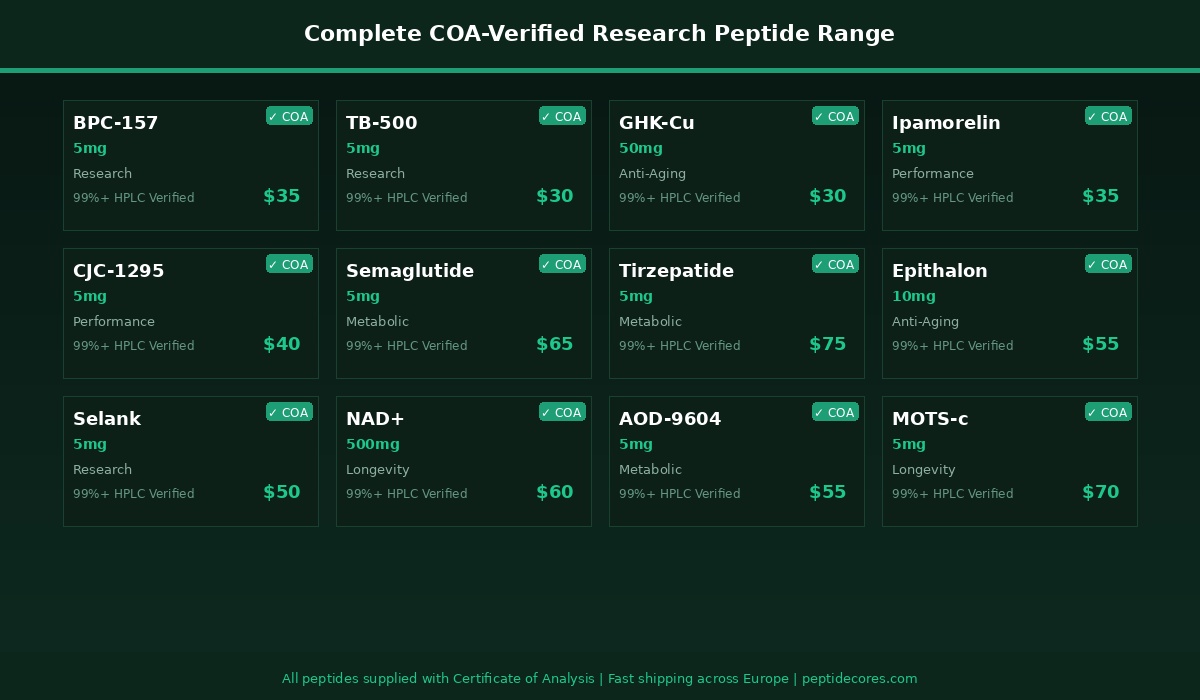
As a peptide supplier with COA verification on every product, PeptideCores maintains a comprehensive range of research peptides across multiple categories. Every compound in our catalogue is supplied with the same rigorous COA documentation regardless of the compound type or order size.
Our tissue repair research peptides include BPC-157 peptide — a synthetic pentadecapeptide extensively studied in cellular biology research — and TB-500 peptide, a synthetic analogue of Thymosin Beta-4 studied in tissue repair and cell migration research.
Our anti-aging and longevity research peptides include GHK-Cu copper peptide studied in skin biology and cellular regeneration research, Epithalon peptide studied in telomere biology and longevity research, NAD+ studied in cellular energy metabolism and sirtuin research, and MOTS-c peptide studied in mitochondrial biology research.
Our performance and growth hormone research peptides include Ipamorelin peptide and CJC-1295 peptide — growth hormone secretagogues studied in endocrine research — alongside GHRP-2 peptide, GHRP-6 peptide, Hexarelin peptide and Sermorelin peptide.
Our metabolic research peptides include Semaglutide peptide, Tirzepatide peptide and AOD-9604 peptide — all supplied with COA documentation as standard.
Choosing a Peptide Supplier with COA for European Research
For researchers based in Europe, choosing a peptide supplier with COA documentation involves additional considerations beyond purity verification. European research institutions operating under quality management frameworks require comprehensive documentation for all research reagents. GDPR compliance in the handling of customer data is also a consideration for European researchers placing orders with international suppliers.
PeptideCores ships research peptides to all European countries with delivery typically arriving within 5 to 10 business days. All orders are dispatched in discreet packaging with no reference to contents on the outer packaging and full tracking provided from dispatch through to delivery. Personal data for all European customers is handled in strict compliance with GDPR regulations.
Our position as a peptide supplier with COA verification specifically serving the European research market means we understand the documentation requirements of European laboratories. Every Certificate of Analysis we supply is formatted to meet standard laboratory documentation requirements and includes all the information needed for research compliance record-keeping.
Red Flags — Peptide Suppliers Without Proper COA Verification
Knowing what to look for when evaluating a peptide supplier with COA claims is as important as knowing what good documentation looks like. Several warning signs indicate that a supplier’s COA documentation may not represent genuine independent verification.
A peptide supplier that provides the same Certificate of Analysis for every order regardless of batch number is not providing batch-specific verification. A COA that does not name the independent testing laboratory that performed the analysis provides weaker assurance than third-party verified documentation. A peptide supplier whose COA shows only a purity percentage without supporting chromatogram data or mass spectrometry results provides limited ability for researchers to independently assess the quality of the testing performed.
Perhaps most significantly, a peptide supplier that is reluctant to discuss their COA documentation or that makes it difficult to obtain certificates before or at the time of ordering should be approached with significant caution. A genuinely confident peptide supplier with COA documentation will make their quality verification process transparent and straightforward to understand.
How to Read the COA from Your Peptide Supplier
When you receive your Certificate of Analysis from PeptideCores or any peptide supplier with COA documentation, there are several key pieces of information to verify before using the compound in research.
First, confirm the batch number on the Certificate of Analysis matches the batch number printed on the product vial label. This confirms the documentation is specific to the compound you received. Second, review the HPLC purity result and confirm it meets your research requirements — for most applications 99% or above represents high quality research grade material. Third, check the mass spectrometry result against the theoretical molecular weight for the peptide to confirm identity. Finally, note the date of analysis and the name of the testing laboratory for your research records.
For a more detailed guide to reading a Certificate of Analysis, see our complete Certificate of Analysis guide which explains every element of the documentation in detail.
Frequently Asked Questions — Peptide Supplier with COA
Does PeptideCores include a COA with every order?
Yes. PeptideCores is a peptide supplier with COA documentation included on every single order regardless of order size or destination. Every COA is batch-specific and includes independent third-party HPLC purity testing and mass spectrometry identity confirmation.
What purity level does your COA confirm?
Our Certificate of Analysis confirms HPLC purity at 99% or above for every research peptide we supply. This applies across our entire range from BPC-157 peptide and TB-500 peptide to Semaglutide peptide and Tirzepatide peptide.
Is your COA from an independent laboratory?
Yes. PeptideCores uses independent third-party laboratory testing for all COA documentation. We do not perform in-house testing and present it as independent verification — all testing is conducted by external laboratories with no commercial relationship to PeptideCores.
Do you ship research peptides with COA to Europe?
Yes. PeptideCores ships research peptides with COA documentation to all European countries. European delivery typically arrives within 5 to 10 business days with full tracking provided.
Can I request a COA before placing an order?
Yes. Contact our team via the contact page and we will provide the relevant Certificate of Analysis documentation for the product you are considering.
Conclusion — PeptideCores as Your Peptide Supplier with COA
Choosing the right peptide supplier with COA verification is a foundational decision for any research programme. The quality of your research compounds directly determines the reliability of your experimental data and the reproducibility of your research findings. PeptideCores was built to serve researchers who understand this — providing independently verified, HPLC tested research peptides with batch-specific Certificate of Analysis documentation on every order shipped across Europe and worldwide.
Browse our complete range of COA verified research peptides and place your order with confidence — every compound we supply is backed by independent third-party verification you can review before use in your laboratory.
Disclaimer
All peptides supplied by PeptideCores are intended for laboratory research purposes only. They are not intended for human or veterinary use, diagnosis, treatment or prevention of any condition or disease. Only qualified researchers should handle these compounds in appropriate laboratory settings following all relevant safety guidelines and regulations.
