Research Guides
What Are Peptides? A Complete Guide for Researchers
Jun
What are peptides? This is one of the most fundamental questions in biochemistry and molecular biology — and one of the most important for any researcher working with research compounds. Peptides are short chains of amino acids linked together by peptide bonds, and they play essential roles in virtually every biological process studied in modern research. At PeptideCores, we supply independently HPLC verified research peptides in Europe at 99%+ purity with a batch-specific Certificate of Analysis included on every order — giving researchers the verified compounds they need for reliable, reproducible results.
What Are Peptides? — The Definition
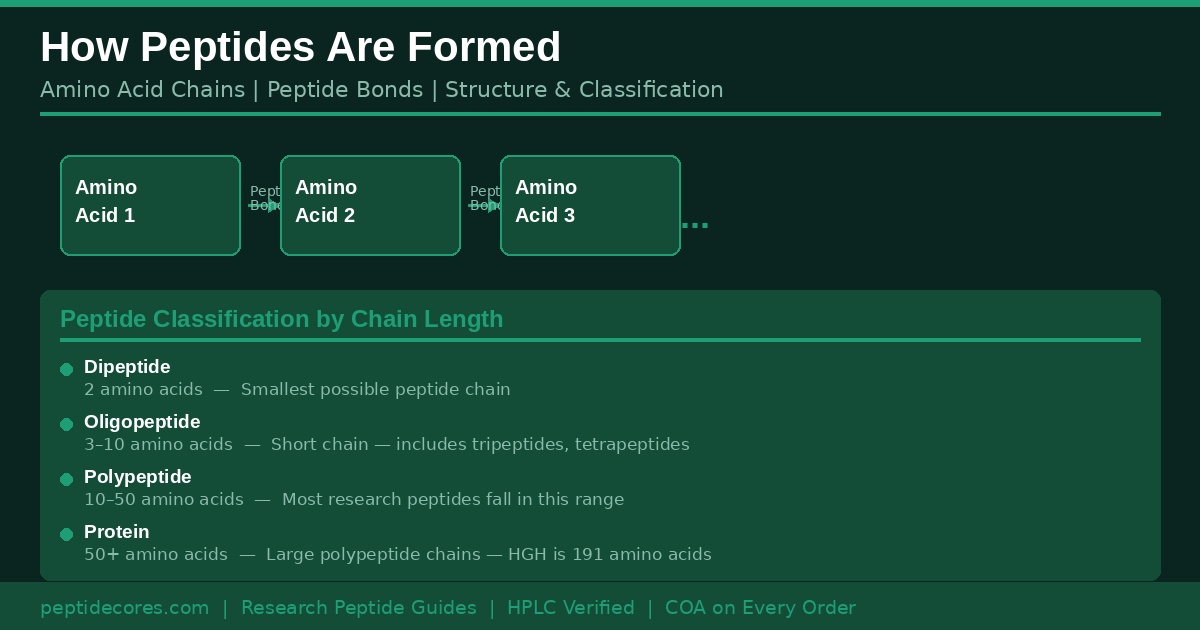
Peptides are short chains of amino acids linked together by peptide bonds. They are essentially smaller versions of proteins — while proteins typically consist of 50 or more amino acids, peptides generally contain between 2 and 50 amino acids. The word peptide comes from the Greek word “peptos” meaning digested, reflecting the fact that peptides were first studied as products of protein digestion in the human body.
Peptides are naturally occurring throughout the human body and play fundamental roles in virtually every biological process. From hormonal signalling to immune function, peptides are essential molecular messengers that regulate how cells communicate and function. Understanding what peptides are at a structural and functional level is essential for any researcher working in cellular biology, biochemistry, endocrinology or related fields.
How Are Peptides Formed?
Peptides are formed when amino acids join together through peptide bonds. A peptide bond forms when the carboxyl group of one amino acid reacts with the amino group of another, releasing a water molecule in the process — a condensation reaction that creates the characteristic backbone of every peptide chain.
The sequence of amino acids in a peptide chain determines its unique molecular properties and biological activity. Even a small change in the amino acid sequence can dramatically alter how a peptide behaves in research settings — modifying its receptor binding affinity, stability, solubility or downstream signalling profile. There are 20 standard amino acids that combine in different sequences to form the enormous variety of peptides found in nature and created synthetically for research purposes.
Natural vs Synthetic Peptides
Peptides can be divided into two main categories — natural and synthetic. Natural peptides occur in the human body and in other organisms. Examples include insulin, oxytocin and endorphins — all of which are peptides that play critical roles in human physiology. Insulin is a 51 amino acid peptide hormone regulating glucose homeostasis. Oxytocin is a 9 amino acid neuropeptide involved in social bonding and parturition. Endorphins are endogenous opioid peptides involved in pain modulation and reward signalling.
Synthetic peptides are created in laboratory settings by chemically joining amino acids in specific sequences using solid-phase peptide synthesis (SPPS) or liquid-phase methods. These synthetic compounds allow researchers to study peptide biology in controlled environments without needing to extract compounds from biological sources. Synthetic peptides can be designed with non-natural amino acid substitutions, modified termini or conjugated functional groups to achieve specific research objectives. Research peptides supplied by PeptideCores are synthetic peptides manufactured to the highest purity standards for in-vitro laboratory research purposes.
Types of Peptides Used in Research
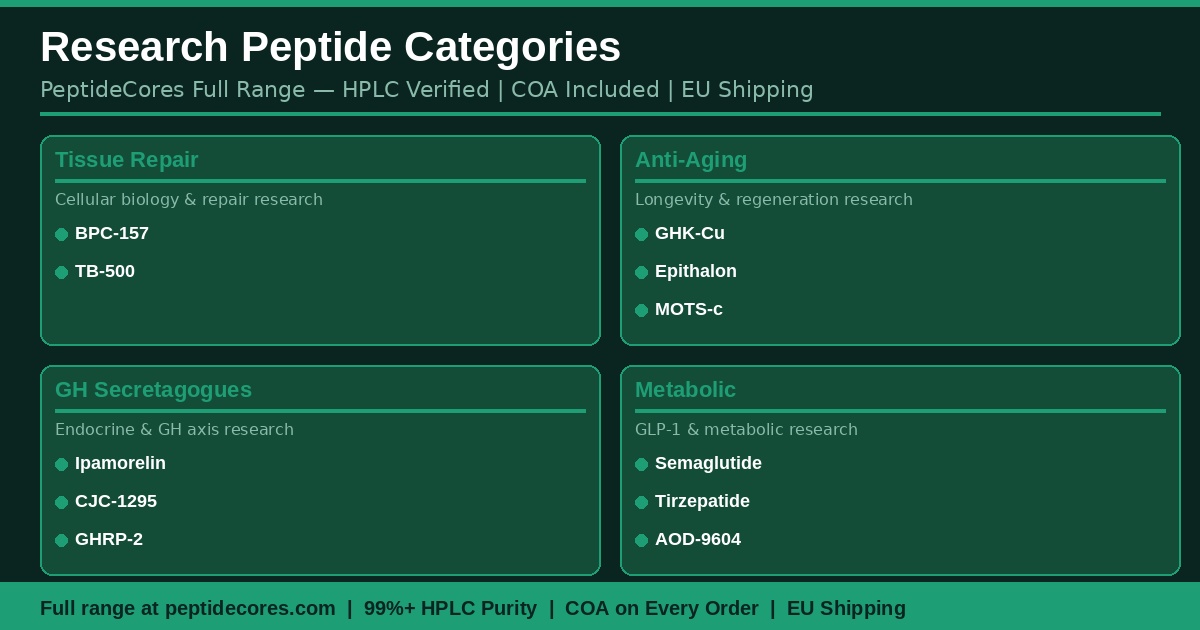
Researchers work with many different types of peptides depending on their area of study. Understanding the main categories of research peptides helps researchers identify the most appropriate compounds for their specific experimental requirements.
Tissue Repair Peptides
Tissue repair peptides are among the most widely studied compounds in cellular biology research. BPC-157 peptide is a synthetic pentadecapeptide studied extensively in cellular repair, angiogenesis and gastrointestinal biology research. TB-500 peptide is a synthetic analogue of Thymosin Beta-4 studied in tissue repair, cell migration and actin dynamics research.
Growth Hormone Releasing Peptides
Growth hormone releasing peptides are synthetic compounds that interact with growth hormone pathways in research models. Ipamorelin peptide is a selective GHRP studied for its clean GH pulse stimulation with minimal cortisol effect. CJC-1295 peptide is a GHRH analogue studied for pituitary GH axis amplification. GHRP-2, GHRP-6, Hexarelin and Sermorelin complete the GH secretagogue research range available from PeptideCores.
Copper Peptides
GHK-Cu peptide is the most extensively studied copper peptide in research. It is a naturally occurring tripeptide — glycine-histidine-lysine — that binds copper ions with high affinity. GHK-Cu is studied in skin biology, wound healing research, collagen synthesis and cellular regeneration programmes.
Metabolic Research Peptides
Semaglutide peptide and Tirzepatide peptide are GLP-1 receptor agonists studied extensively in metabolic biology, appetite regulation and pancreatic beta cell research. AOD-9604 is a modified fragment of human growth hormone studied in adipose tissue and metabolic research.
Anti-Aging and Longevity Peptides
Epithalon peptide is a tetrapeptide studied in telomere biology and longevity research. MOTS-c peptide is a mitochondria-derived peptide studied in metabolic regulation and cellular energy research. NAD+ is studied in cellular energy metabolism and sirtuin pathway research.
Why Peptide Purity Matters in Research
When working with research peptides, purity is absolutely critical to experimental validity. Impure compounds can compromise research results and make it impossible to draw reliable conclusions from experimental data. If a peptide contains synthesis byproducts, related sequence impurities or incorrect molecular identity, any conclusions drawn from research using that compound become unreliable.
At PeptideCores all research peptides are independently verified at 99%+ purity by High Performance Liquid Chromatography testing conducted by third-party laboratories. Every batch comes with a Certificate of Analysis confirming purity level and molecular identity before dispatch — providing researchers with the documentation needed for both experimental confidence and laboratory record keeping.
What Is HPLC Testing?
High Performance Liquid Chromatography is the gold standard method for verifying research peptide purity. HPLC works by passing a sample through a specialised column that separates compounds based on their molecular properties — polarity, size and interaction with the stationary phase. The separation produces a chromatogram showing exactly what compounds are present in the sample and in what relative quantities.
A 99%+ HPLC purity result confirms that at least 99% of the compound is the target peptide with no more than 1% attributable to impurities, synthesis byproducts or related peptide sequences. All PeptideCores research peptides are independently HPLC verified before dispatch by third-party laboratories with no commercial relationship to PeptideCores. For a full explanation of COA documentation see our Certificate of Analysis guide.
How to Store Research Peptides
Proper storage is essential for maintaining peptide integrity and ensuring experimental reproducibility. Lyophilised freeze-dried peptides should be stored at −20°C away from direct light and moisture. Under these conditions most research peptides remain stable for up to 24 months from the manufacture date. Once reconstituted, peptides should be stored at 4°C and used within timeframes appropriate to the specific compound and your laboratory protocol. For a complete storage protocol see our research peptide storage guide.
Where to Buy Research Peptides in Europe
When purchasing research peptides it is essential to choose a supplier that prioritises purity verification and documentation transparency. Always look for independent third-party HPLC testing, a batch-specific Certificate of Analysis provided with every order, secure encrypted ordering and discreet EU shipping. PeptideCores supplies research peptides meeting all of these standards — providing European researchers with access to a full range of verified compounds from a single dedicated supplier.
Browse our complete range including BPC-157 peptide, TB-500 peptide, GHK-Cu peptide, Ipamorelin peptide and CJC-1295 peptide — all HPLC verified at 99%+ purity with COA included as standard on every single order.
Frequently Asked Questions — What Are Peptides?
What is the difference between a peptide and a protein?
Peptides contain between 2 and 50 amino acids while proteins contain 50 or more. The distinction is based on chain length — shorter chains are peptides, longer chains are proteins. Some sources define the boundary at 100 amino acids. In practice, many research compounds described as peptides — such as Semaglutide at 31 amino acids — are clearly in the peptide range.
What are synthetic research peptides?
Synthetic research peptides are amino acid chains produced by chemical synthesis in laboratory settings rather than extracted from biological sources. They are designed for use in laboratory research to investigate specific biological pathways, receptor mechanisms and cellular processes in controlled experimental settings.
Why is HPLC purity important for research peptides?
HPLC purity verification confirms that the compound is what it claims to be and is free from significant impurities. Using impure compounds in research can produce false results, compromise experimental reproducibility and invalidate research conclusions. 99%+ HPLC purity is the standard for research grade compounds.
What research peptides does PeptideCores supply?
PeptideCores supplies over 30 research peptides across tissue repair, anti-aging, GH secretagogue and metabolic categories — including BPC-157, TB-500, GHK-Cu, Ipamorelin, CJC-1295, Semaglutide, Tirzepatide, Epithalon and more. All are independently HPLC verified at 99%+ purity with COA documentation on every order.
Do you ship research peptides to Europe?
Yes. PeptideCores ships research peptides to all European countries with delivery typically within 5 to 10 business days. Full tracking is provided from dispatch and all European orders are handled in compliance with GDPR data regulations.
Conclusion
Peptides are fundamental molecules in biological research — short amino acid chains that function as molecular messengers, receptor ligands, enzyme substrates and structural components across virtually every system in living organisms. Understanding what peptides are, how they are formed and how they are classified is foundational knowledge for any researcher working in biochemistry, cellular biology or related fields.
PeptideCores is committed to supplying the highest quality research peptides in Europe — every compound independently HPLC verified at 99%+ purity with a batch-specific Certificate of Analysis included as standard on every single order dispatched across Europe and worldwide.
Disclaimer
All peptides supplied by PeptideCores are intended for laboratory research purposes only. They are not intended for human or veterinary use, diagnosis, treatment or prevention of any condition or disease. Only qualified researchers should handle these compounds in appropriate laboratory settings following all relevant safety guidelines and regulations.
