
Research Guides
What is a Certificate of Analysis (COA)? A Researcher’s Guide to Peptide Purity Verification
Jun
What is a Certificate of Analysis? For anyone purchasing research peptides, this is one of the most important questions to understand before placing an order. A Certificate of Analysis, commonly abbreviated as COA, is the single most important document a research peptide supplier can provide — yet many researchers are unsure exactly what information a COA should contain or how to verify that it is genuine. This complete guide explains what a Certificate of Analysis is, why it matters for research peptide purity, what information it should include and how to read one correctly.
What is a Certificate of Analysis?
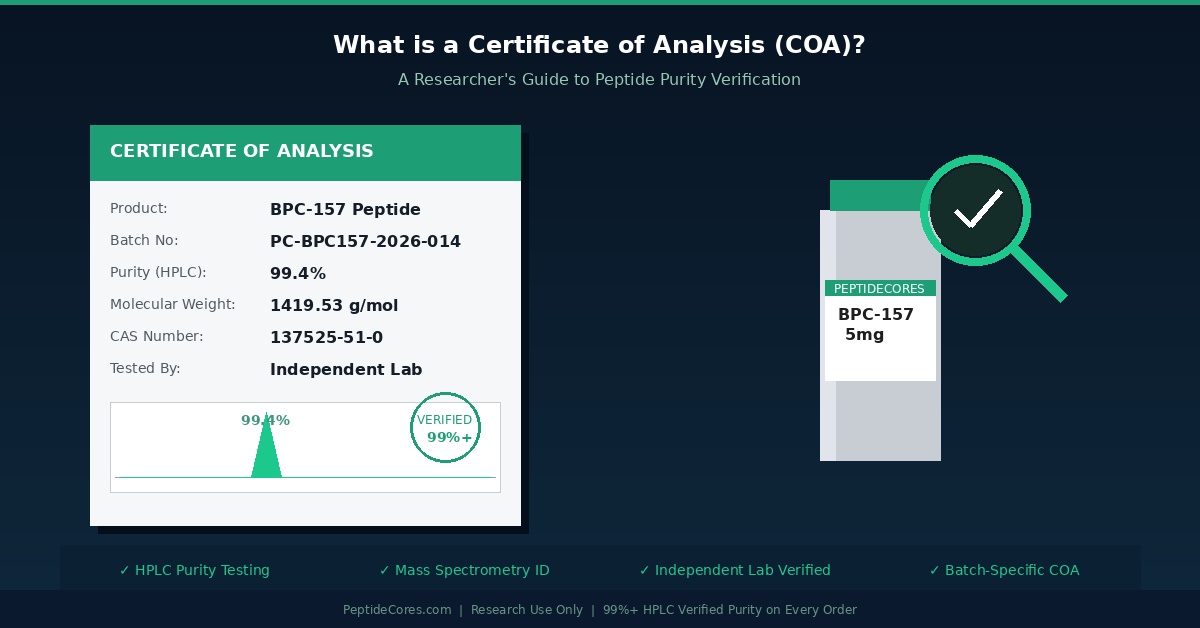
A Certificate of Analysis is a document issued by an independent testing laboratory that confirms the identity, purity and quality of a specific batch of a compound. For research peptides, a Certificate of Analysis verifies that the peptide supplied matches its stated identity and meets the purity percentage claimed by the supplier.
Every batch of research peptide produced by a manufacturer is assigned a unique batch or lot number. The Certificate of Analysis corresponds specifically to that batch number — meaning the COA you receive should match the batch number printed on the vial label of the product you received. This batch-specific nature of a Certificate of Analysis is what distinguishes genuine third-party verification from generic marketing claims.
At PeptideCores, every single product is supplied with a Certificate of Analysis confirming purity at 99% or above by High Performance Liquid Chromatography, along with mass spectrometry confirmation of molecular identity. This applies across our entire range including BPC-157 peptide, TB-500 peptide, GHK-Cu peptide and every other compound we supply.
Why a Certificate of Analysis Matters for Research Peptides
Research integrity depends entirely on knowing exactly what compound you are working with. Without a Certificate of Analysis, a researcher has no independent verification that the peptide in a vial is what the label claims, or that it meets any meaningful purity standard. This is not a minor technicality — it is the foundation of reproducible research.
Consider the implications of working with an unverified compound. If a peptide is significantly less pure than claimed, contains unexpected byproducts from synthesis, or is not the peptide stated on the label at all, any research conclusions drawn from experiments using that compound become unreliable. A Certificate of Analysis is the documented evidence that allows researchers to proceed with confidence.
For institutions and laboratories operating under quality management systems, a Certificate of Analysis is often a compliance requirement. Maintaining proper documentation of reagent and compound purity is standard practice in laboratories following good laboratory practice principles. A supplier that cannot provide a Certificate of Analysis for every batch should be treated with significant caution.
What Information Should a Certificate of Analysis Include?
A genuine, complete Certificate of Analysis for a research peptide should contain several specific pieces of information. Understanding what to look for helps researchers distinguish between thorough, legitimate documentation and superficial certificates that provide little real verification.
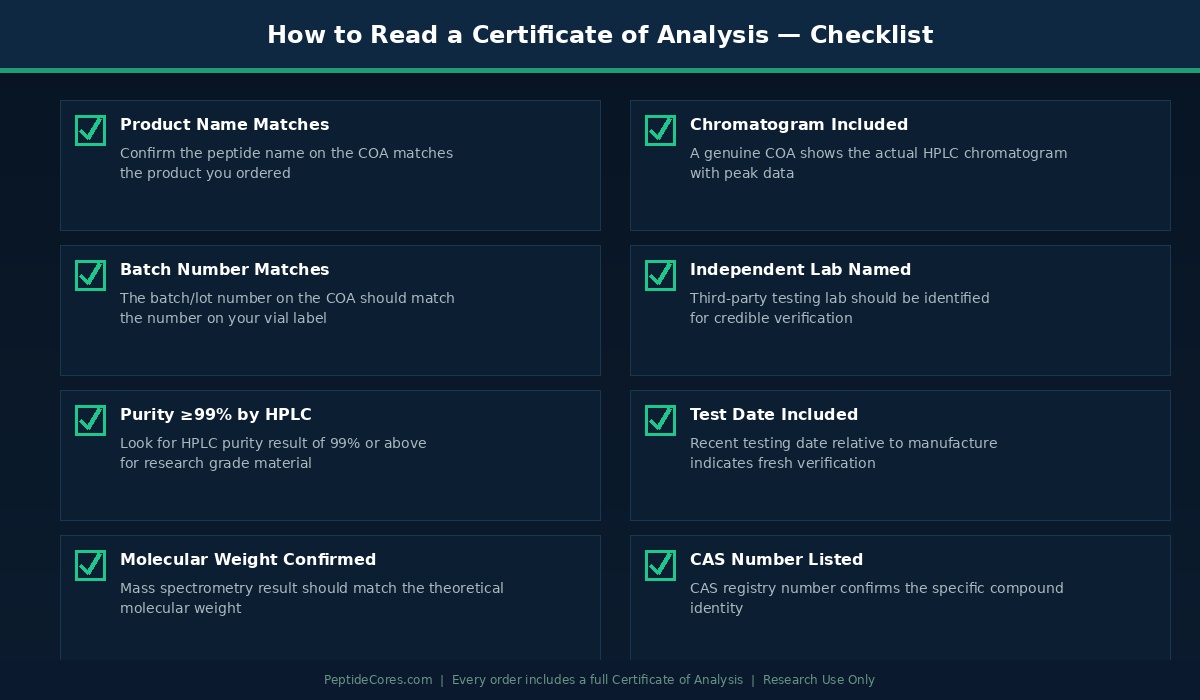
Product name and batch number. The COA should clearly state the name of the peptide and the specific batch or lot number it applies to. This batch number should match the number printed on the product label you received.
Purity percentage. The COA should state the purity of the peptide as determined by HPLC analysis, typically expressed as a percentage. For high quality research peptides, this figure should be 99% or above.
Molecular weight confirmation. Mass spectrometry results confirming the molecular weight of the compound should be included, verifying that the peptide’s molecular identity matches its stated sequence.
HPLC chromatogram. A genuine Certificate of Analysis often includes the actual chromatogram output from the HPLC testing process, showing the peaks that correspond to the target peptide and any detected impurities.
Testing laboratory information. The COA should indicate which laboratory performed the testing. Independent third-party testing carries more weight than in-house testing performed by the manufacturer itself.
Date of analysis. The date the testing was conducted should be included, allowing researchers to understand how recently the batch was verified relative to its manufacture date.
Understanding HPLC Testing for Peptide Purity
High Performance Liquid Chromatography, commonly abbreviated as HPLC, is the gold standard analytical method used to verify peptide purity and is the primary testing method referenced on most Certificates of Analysis. Understanding how HPLC works helps researchers interpret the results presented on a COA.
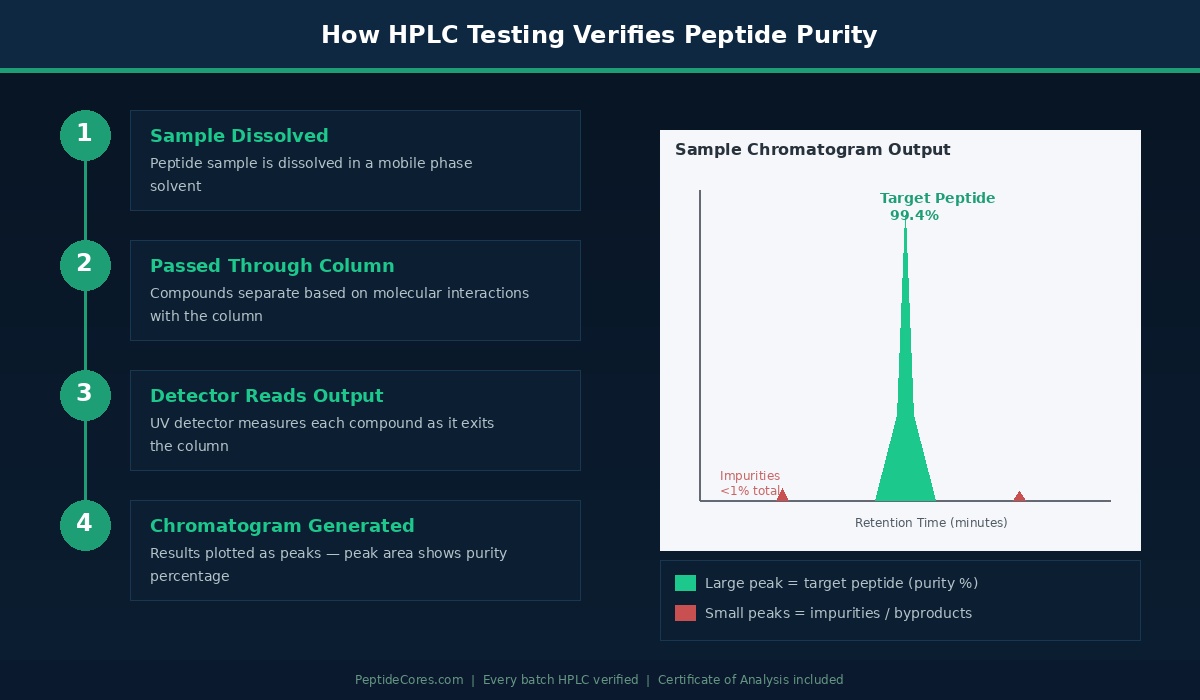
HPLC works by passing a dissolved sample of the peptide through a column packed with a stationary phase material under high pressure. Different compounds in the sample interact differently with the stationary phase, causing them to travel through the column at different speeds. This separates the sample into its individual components, which are detected as they exit the column, typically using UV absorbance detection.
The output of an HPLC analysis is a chromatogram — a graph showing detector response over time. Each compound in the sample appears as a peak on this chromatogram. For a research peptide, the target compound should appear as a single dominant peak, with the area under this peak relative to the total area under all peaks giving the purity percentage. A 99% purity result means the target peptide peak represents 99% of the total peak area, with the remaining 1% representing impurities, degradation products or synthesis byproducts.
When reviewing a Certificate of Analysis that includes a chromatogram, researchers should look for a single clean, sharp peak corresponding to the target peptide with minimal additional peaks. Multiple significant peaks alongside the main peak would indicate the presence of impurities and a lower effective purity than claimed.
Mass Spectrometry and Molecular Identity Verification
While HPLC verifies purity, mass spectrometry verifies molecular identity — confirming that the compound present is actually the peptide it claims to be, not simply a pure compound of unknown identity. Mass spectrometry works by ionising the sample and measuring the mass-to-charge ratio of the resulting ions, which can be matched against the expected molecular weight of the target peptide.
For a research peptide, a Certificate of Analysis should report a mass spectrometry result that closely matches the theoretical molecular weight calculated from the peptide’s amino acid sequence. For example, BPC-157 peptide has a theoretical molecular weight of 1419.53 g/mol. A Certificate of Analysis for a BPC-157 batch should report a mass spectrometry result close to this value, confirming that the compound tested is indeed BPC-157 and not a different peptide or compound entirely.
The combination of HPLC purity testing and mass spectrometry identity confirmation provides researchers with two independent lines of evidence: that the compound is pure, and that the compound is what it claims to be. A Certificate of Analysis lacking either of these elements provides incomplete verification.
Red Flags — When a Certificate of Analysis Should Raise Concerns
Not all documents labelled as a Certificate of Analysis provide meaningful verification. Researchers should be aware of several warning signs that indicate a COA may not represent genuine independent testing.
Generic certificates not tied to a specific batch. If a supplier provides the same Certificate of Analysis for every order regardless of batch number, this suggests the certificate may not correspond to the actual product received.
Missing testing laboratory information. A Certificate of Analysis that does not state which laboratory performed the testing, or that appears to be self-issued by the manufacturer without independent verification, provides weaker assurance than third-party testing.
No chromatogram or raw data. A Certificate of Analysis that states only a purity percentage without any supporting chromatogram or analytical data provides limited ability for researchers to independently assess the quality of the testing.
Purity percentages that seem inconsistent. If a Certificate of Analysis reports purity above what is realistically achievable for the synthesis method used, or if purity figures vary implausibly between batches without explanation, this warrants further scrutiny.
Unwillingness to provide a COA before purchase. Reputable suppliers should be willing to share Certificate of Analysis documentation, or at minimum confirm that one will be provided with the order. Reluctance to discuss quality documentation is a significant red flag.
How PeptideCores Approaches Certificate of Analysis Documentation
At PeptideCores, every product is supplied with a complete Certificate of Analysis specific to the batch shipped. Our quality assurance process includes independent third-party HPLC testing confirming purity at 99% or above, alongside mass spectrometry confirmation of molecular identity for every compound we supply.
This applies across our entire catalogue — from established research compounds like BPC-157 peptide and TB-500 peptide, to growth hormone secretagogues including Ipamorelin peptide and CJC-1295 peptide, to metabolic research compounds such as our Semaglutide and Tirzepatide peptides, anti-aging research compounds including GHK-Cu peptide and NAD+, and specialised research peptides including AOD-9604 peptide and MOTS-c peptide.
We believe research integrity depends entirely on compound purity, and that researchers deserve complete transparency about what they are working with. A Certificate of Analysis is not an optional extra — it is a fundamental part of what makes a research peptide order trustworthy.
How to Request and Verify Your Certificate of Analysis
When you place an order with PeptideCores, the Certificate of Analysis corresponding to your specific batch is provided alongside your order. We recommend researchers take the following steps when receiving a new batch of research peptide.
First, check that the batch number on the Certificate of Analysis matches the batch number printed on the product label. This confirms the documentation corresponds to the actual product received rather than a generic certificate.
Second, review the purity percentage and confirm it meets your research requirements — for most applications, 99% or above by HPLC represents high quality research grade material.
Third, check the mass spectrometry result against the theoretical molecular weight for the peptide. A close match confirms molecular identity.
Finally, retain the Certificate of Analysis as part of your laboratory documentation. Many institutions require this documentation to be kept on file as part of standard record keeping practices for research materials.
Frequently Asked Questions
What is a Certificate of Analysis used for?
A Certificate of Analysis is used to verify the purity, identity and quality of a specific batch of a compound. For research peptides, it provides independent confirmation that the product matches its stated specification before it is used in laboratory research.
Is a Certificate of Analysis the same for every order?
No. A genuine Certificate of Analysis corresponds to a specific batch number. Different batches of the same peptide may have slightly different Certificates of Analysis reflecting the testing results for that particular batch.
What purity level should I look for on a Certificate of Analysis?
For research grade peptides, a purity of 99% or above by HPLC is considered high quality. PeptideCores supplies all research peptides at 99%+ purity with Certificate of Analysis documentation confirming this for every batch.
Does PeptideCores provide a Certificate of Analysis with every order?
Yes. Every product supplied by PeptideCores includes a Certificate of Analysis confirming HPLC purity testing and mass spectrometry identity verification for the specific batch shipped.
Conclusion
A Certificate of Analysis is the cornerstone of research peptide quality assurance. It provides independent, batch-specific verification of purity through HPLC testing and confirmation of molecular identity through mass spectrometry. Understanding what a Certificate of Analysis should contain — and recognising the warning signs of inadequate documentation — empowers researchers to make informed decisions about the compounds they use in their work.
At PeptideCores, every product across our research peptide range is supplied with a complete Certificate of Analysis as standard, reflecting our commitment to research integrity and transparency. Browse our full range of research peptides to see our complete COA-verified catalogue.
Disclaimer
All peptides supplied by PeptideCores are intended for laboratory research purposes only. They are not intended for human or veterinary use, diagnosis, treatment or prevention of any condition or disease. Only qualified researchers should handle these compounds in appropriate laboratory settings following all relevant safety guidelines and regulations.

Pingback: Peptide Supplier With COA | HPLC Verified | PeptideCores